
Your Thyroid Can’t Build From an Empty Toolbox
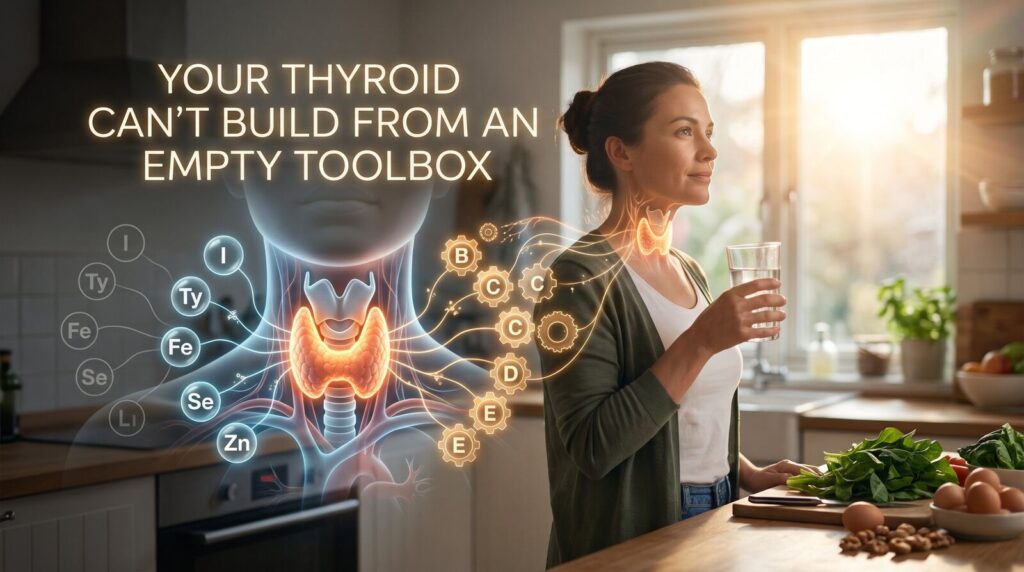
You wake up tired, you're cold when everyone else is comfortable, your hair is thinner than it used to be, and your brain feels like it's wading through fog. Maybe you've even been told your thyroid "looks fine."
If that's you, I want you to hear this first: you're not lazy, you're not imagining it, and you're not alone. In our community, this is one of the most common stories we hear. And it's one of the most hopeful ones, because the thyroid is a gland that responds when you give it what it needs.
Let's start at the very beginning: how your thyroid actually makes hormone.
Educate: The Science of Making Thyroid Hormone
Think of your thyroid as a small factory at the base of your neck. Its main product is a hormone called T4. T4 is a storage form of hormone that your body later converts into the active form, T3.
Like any factory, your thyroid can only produce what its supplies allow. It needs specific raw materials and specific tools.
The raw materials
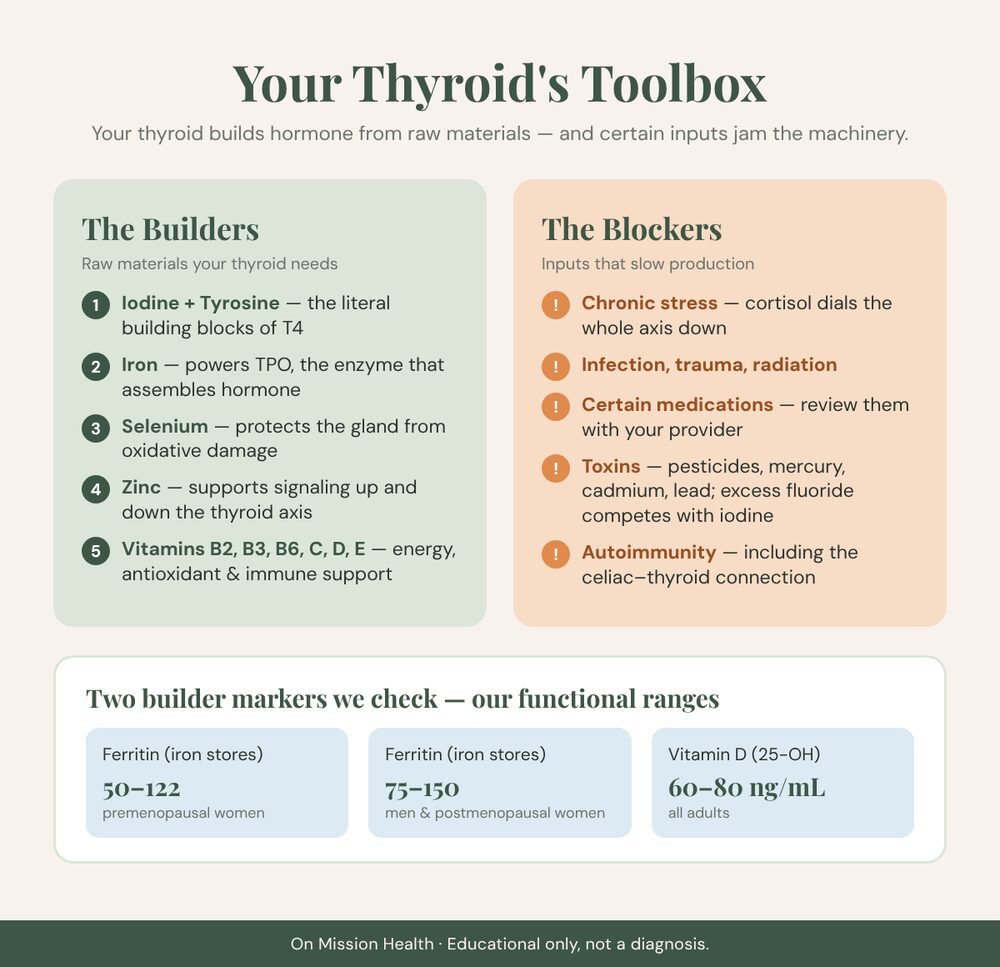
Iodine and tyrosine are the literal building blocks of thyroid hormone. Tyrosine (an amino acid from protein) forms the backbone, and iodine atoms are attached to it. The "4" in T4 stands for four iodine atoms.
The tools
- Iron. The enzyme that assembles thyroid hormone, thyroid peroxidase (TPO), depends on iron to work. Research has shown that iron deficiency sharply reduces TPO activity and impairs thyroid metabolism, and that iron-deficiency anemia even blunts the benefit of iodine.1,2 This is one of the most overlooked thyroid connections I see, especially in women with heavy cycles.
- Selenium. Making thyroid hormone generates oxidative stress inside the gland, and selenium-based enzymes act as the cleanup crew. Adequate selenium supports hormone production and protects the gland from damage.1 In people with Hashimoto's, a large 2024 meta-analysis of randomized trials found that selenium supplementation modestly lowered TSH and thyroid antibodies.3
- Zinc. Zinc supports signaling all along the thyroid axis, from the brain down to the gland.
- Supporting vitamins: B2, B3, B6, C, D and E. These fuel the energy reactions, antioxidant defense and immune balance the whole process depends on.
What jams the machinery
Supplies are only half the story. Certain inputs actively slow production:
- Chronic stress. Stress hormones suppress the brain's signal to the thyroid.
- Infection, trauma and radiation.
- Certain medications.
- Environmental toxins like pesticides, mercury, cadmium and lead. Fluoride is chemically similar to iodine and can compete with it. One large English study found that areas with higher fluoride in drinking water reported higher rates of diagnosed hypothyroidism.4 That was an observational study and is still debated, but it's a reason to be mindful of your total exposure.
- Autoimmunity. Autoimmune conditions cluster together. A meta-analysis of nearly 95,000 people found that those with celiac disease have about three times the odds of thyroid disease compared with controls.5 When the immune system is reacting to the gut, the thyroid is often caught in the crossfire.
Inspire: Your Body Isn't Failing You. It's Rationing.
Here's the mindset shift I want you to take with you.
When your thyroid slows down, it isn't broken. It's being smart. A factory that's short on iron, selenium and protein, or flooded with stress signals and toxins, should slow production. Your body is doing exactly what it was designed to do with the inputs it's been given.
That's the good news. If the inputs created the problem, changing the inputs can change the outcome. You aren't powerless, and you aren't destined to just "manage symptoms" forever.
I'm here for you 100%. I'll do the digging, the testing and the interpreting with you. But you hold the keys. Every meal, every night of sleep and every choice about your environment is a chance to restock your toolbox.
Empower: 4 Action Steps You Can Start Today
- Eat for your thyroid, not against it. Build each meal around quality protein (for tyrosine), and rotate in thyroid-friendly foods: eggs, wild seafood, pasture-raised meats, pumpkin seeds (zinc), and a Brazil nut or two for selenium. More isn't better with selenium or iodine, so food first.
- Know your iron and vitamin D numbers, not just your TSH. Ask for a ferritin and a 25-OH vitamin D test. In our practice, the functional ranges we use are ferritin 50–122 for premenopausal women and 75–150 for men and postmenopausal women, and vitamin D at 60–80 ng/mL.
- Reduce your toxic load. Filter your drinking water, choose organic for the most heavily sprayed produce, and be mindful of large predatory fish that can carry mercury.
- Work with a functional medicine practitioner who digs deep. That means appropriate testing (a full thyroid panel with antibodies, plus iron, nutrients and gut markers), a thorough history, someone who truly listens, and an in-depth assessment to find the root cause rather than just treating a number.
Sick and tired of being sick and tired? It's time.
Getting healthy, and staying healthy, takes three things: the right dedication, the right doctor (one with the education, mentality and experience to look beneath the surface), and daily lifestyle input based on a plan built for your body.
You don't have to figure this out alone. That's why we're building this community: people getting healthy and staying healthy, together.
Book your visit with On Mission Health →
The Research Behind This Article
- Zimmermann MB, Köhrle J. The impact of iron and selenium deficiencies on iodine and thyroid metabolism: biochemistry and relevance to public health. Thyroid. 2002;12(10):867-878.
- Hess SY, Zimmermann MB, et al. Iron deficiency anemia reduces thyroid peroxidase activity in rats. J Nutr. 2002;132(7):1951-1955.
- Huwiler VV, et al. Selenium supplementation in patients with Hashimoto thyroiditis: a systematic review and meta-analysis of randomized clinical trials. Thyroid. 2024;34(3):295-313.
- Peckham S, Lowery D, Spencer S. Are fluoride levels in drinking water associated with hypothyroidism prevalence in England? J Epidemiol Community Health. 2015;69(7):619-624.
- Sun X, et al. Increased incidence of thyroid disease in patients with celiac disease: a systematic review and meta-analysis. PLoS One. 2016;11(12):e0168708.
This article is for educational purposes only and is not medical advice, diagnosis or treatment. Please consult a qualified healthcare provider before making changes to your health plan, medications or supplements.