
Your Labs Say “Optimal.” So Why Don’t You Feel Optimal?

You did the right thing. You got your blood work done, and every result came back green. "Optimal," all the way down the page.
But you're still tired. Your thinking is still foggy, the weight won't move, and you don't sleep well. Eventually you start to wonder whether it's all in your head.
It isn't. There's a gap between "nothing is wrong enough to diagnose" and "truly thriving," and a lot of people live in that gap for years. Here we close it together. You're not doing this alone. You're part of a community of people learning to read their own bodies and take their health back.
Same Report, Two Lenses
Where "normal" comes from
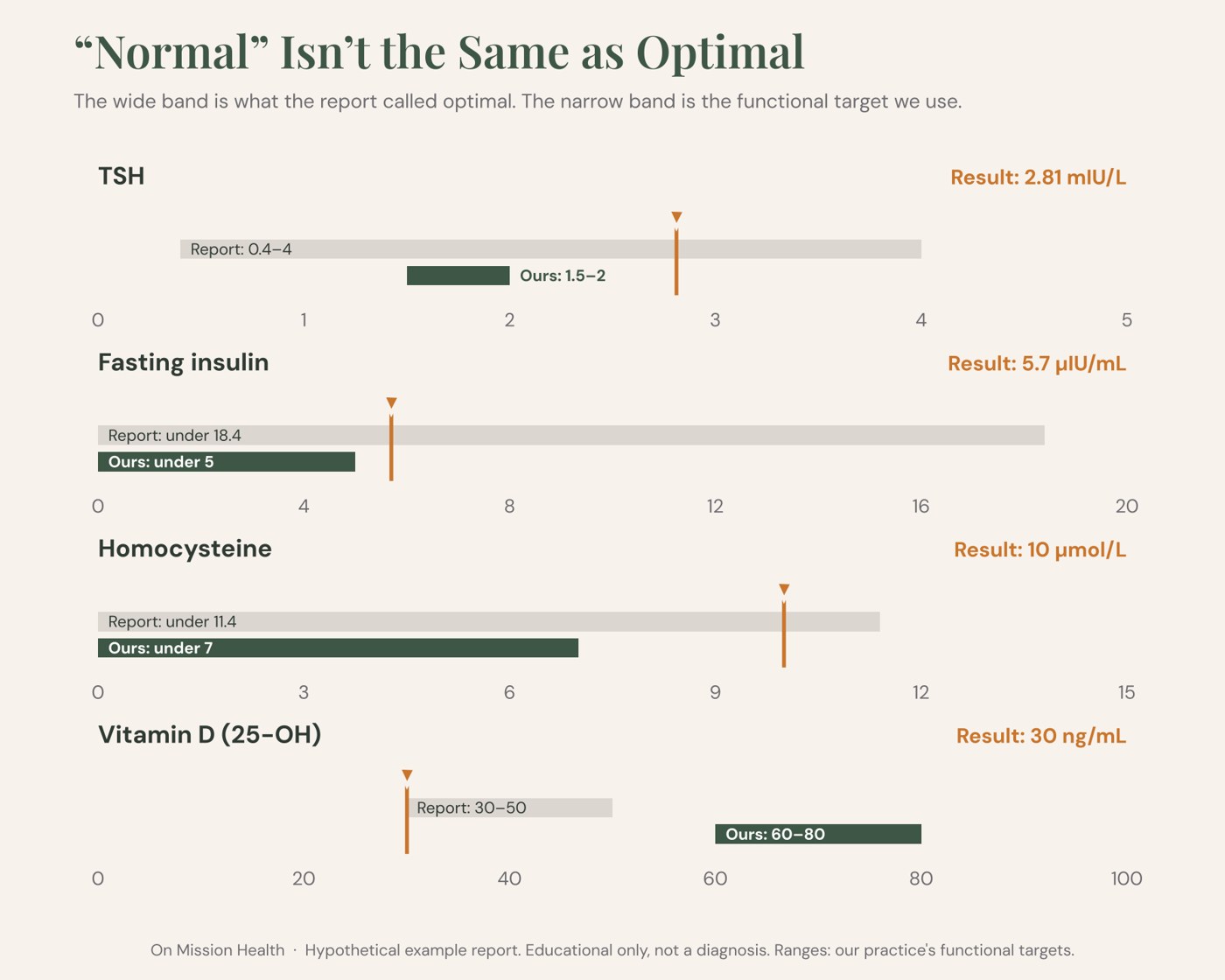
The range printed on your lab report doesn't describe what's healthy. It's a statistical snapshot of the people who got tested, roughly the middle 95%. Many of those people are overweight, under-slept, inflamed or already living with chronic illness. So "normal" really means typical, and typical health today isn't something to aim for.
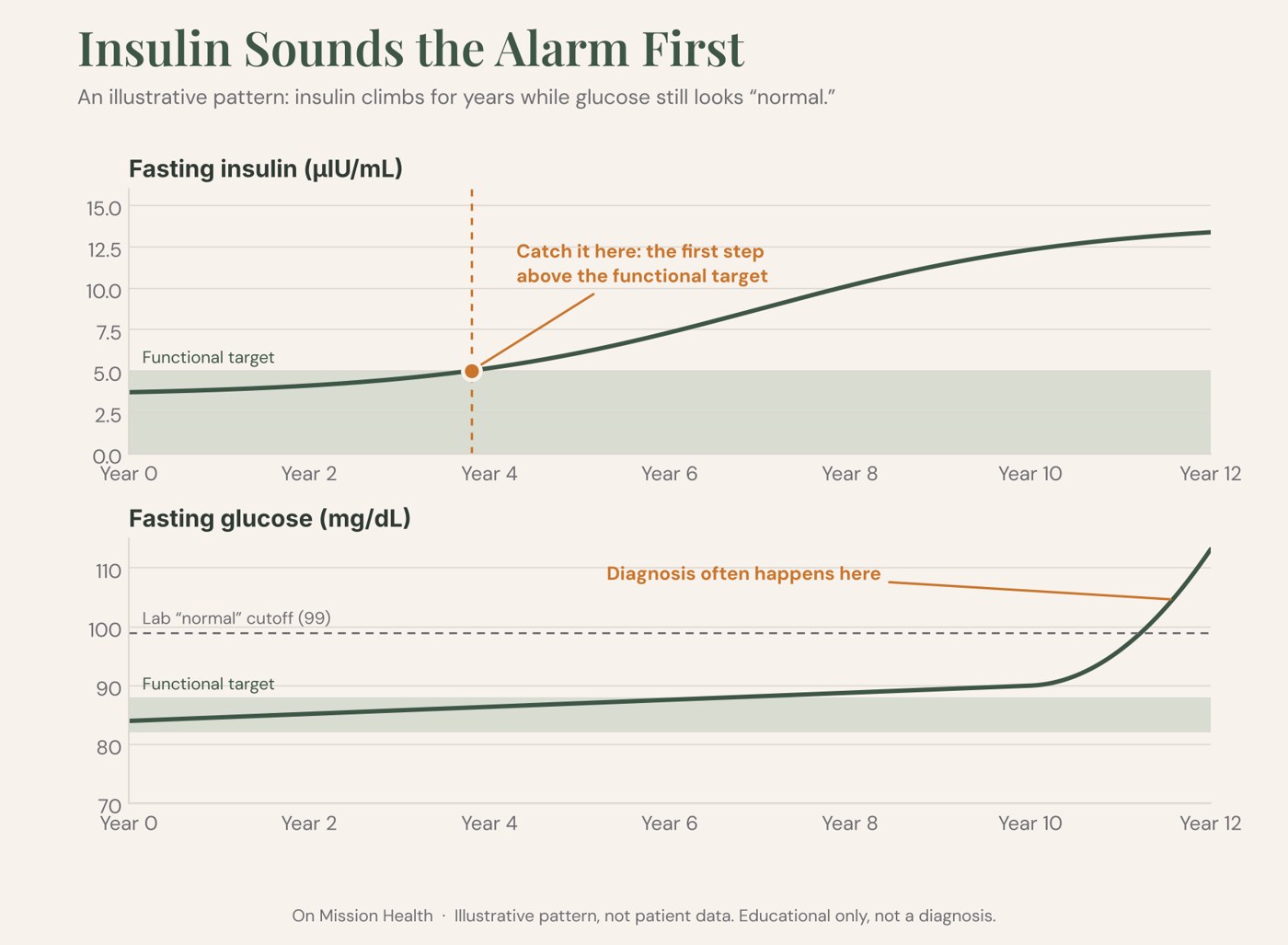
Standard ranges are built to catch disease that's already there. They aren't designed to catch the slow drift that comes before it, and that drift can go on for 5, 10 or 15 years before a diagnosis.
Some reports go a step further and label results "optimal" using ranges almost as wide as the standard ones. A green label doesn't always mean a functional lens was applied.
One report, read twice
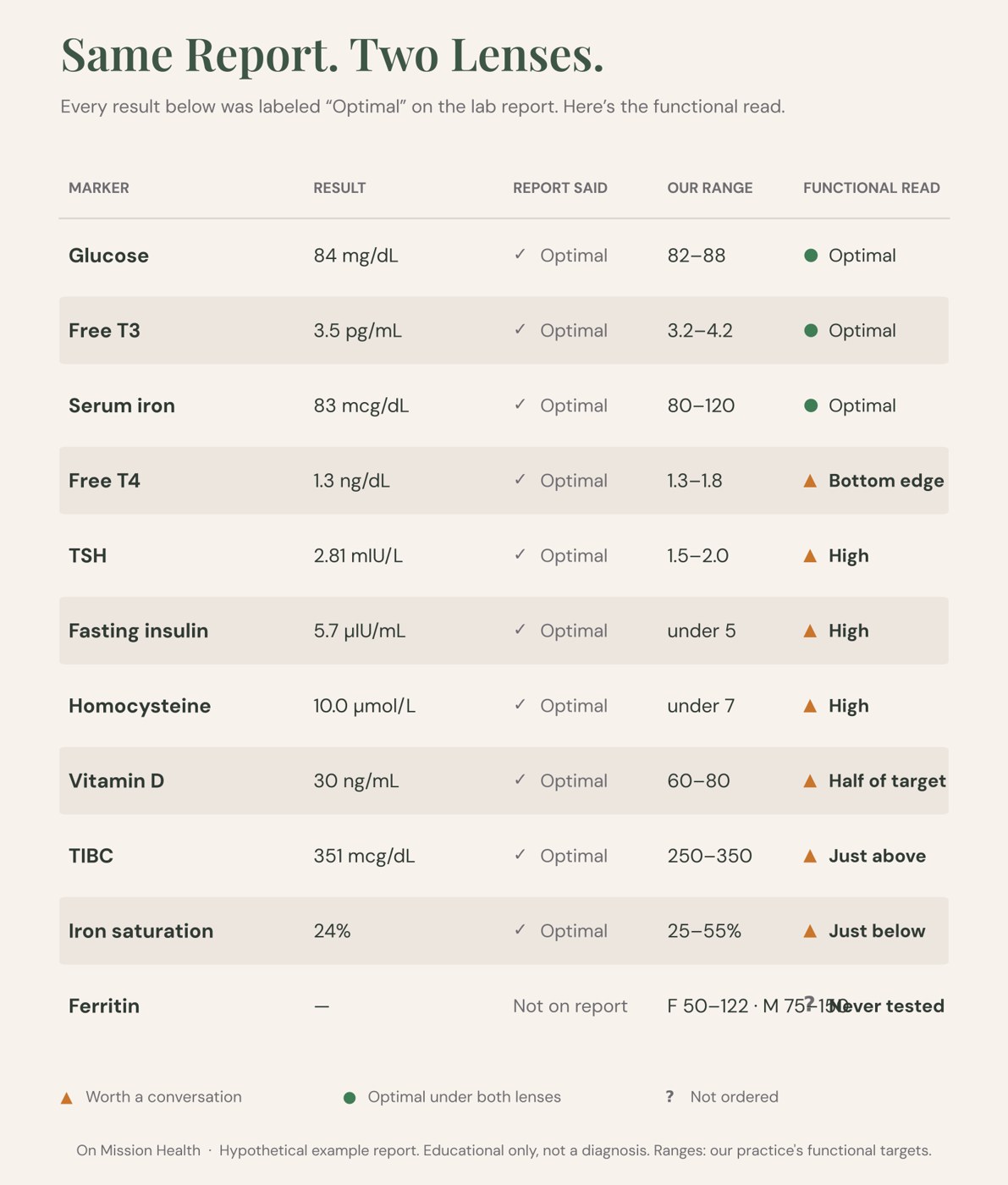
The report below is a hypothetical example, but it's the kind of lab I see every day in my practice. Every result is stamped "within normal limits," and the patient is told everything is fine. They aren't fine, because those values aren't at optimal physiological levels. Read through the functional ranges we use in our practice, seven results deserve a conversation, and ferritin, the most important iron-storage marker, was never ordered.
Why the pattern matters more than any single number
Your body is a network. Thyroid, blood sugar, methylation and nutrient status all affect each other. In this example:
- TSH is high and free T4 sits at the bottom edge. The brain is pushing harder on a thyroid that's barely keeping up. That can show up as fatigue, feeling cold or a sluggish metabolism, long before a thyroid diagnosis.
- Homocysteine is high. That points to methylation, the process your body uses to make energy, process hormones and protect blood vessels. B12, folate, B6 and your genetics (such as MTHFR variants) all play a role.
- Vitamin D is at half the functional target. Vitamin D supports immune function, mood, bone health and even thyroid function.
- Fasting insulin is just above target. It's one of the earliest warning lights for metabolic trouble.
Insulin rises first
Fasting insulin deserves its own spotlight. Your pancreas can quietly work harder and harder for years to keep blood sugar looking "normal." By the time glucose finally rises, the problem has been building for a long time. The moment to act is the first step above the functional target, while it's easiest to turn around.
Functional ranges are used for education and early detection. They aren't a diagnosis, and they're always interpreted alongside your symptoms, history and genetics.
Your Body Isn't Failing You
Your symptoms aren't a malfunction. Your body is responding, accurately, to what it has been given: the food, the sleep, the stress, the light, the movement, and your own genetic blueprint.
That's good news. A body that responds predictably to its inputs is a body that can change when the inputs change. A rising insulin level, a sluggish thyroid signal or low vitamin D isn't a life sentence. It's a message, and you can answer it.
My job is to help you read that message and understand your physiology, genetics and history, so you aren't depending on anyone, including me, to tell you how you feel. I'm here for you 100%. But you hold the keys.
Five Steps You Can Start Today
- Get copies of all your labs. Gather results from the last few years into one folder. Trends tell us more than any single snapshot, and you can't see a trend you don't have.
- Ask for the markers that often get left out. Fasting insulin, ferritin, free T3, homocysteine and vitamin D are inexpensive and reveal a great deal. Test in the morning after an overnight fast.
- Pair your numbers with your symptoms. Write down your top three symptoms, how long you've had them, and what makes them better or worse. Labs plus your lived experience give us the real picture.
- Start one foundational habit this week. Take a 10–15 minute walk after your largest meal. It's one of the simplest, best-supported ways to lower the blood sugar and insulin spike after eating. Small inputs, repeated daily, change your labs.
- Work with a functional medicine practitioner who will truly dig deep. Look for someone who runs the appropriate testing, takes a thorough history, listens to everything you say, and does a real in-depth assessment of every part of your situation. That's how we find your root cause and finally start getting you better.
Then retest every 3–6 months, so you can see in black and white that what you're doing is working. Share your wins with our community. Your progress is proof for someone who's still stuck in "normal."
Sick and Tired of Being Sick and Tired? It's Time.
You can start the journey to optimal health too. It takes three things: the right dedication, the right doctor with the right education, mentality and experience, and your daily commitment to optimizing your lifestyle based on the plan built for you.
Book your functional medicine consultation and let's find your root cause together.
This article is for education only and is not medical advice. Talk with your healthcare provider before making changes to your care.